


For most people, the third-quarter estimated payment is the one they least think about. You paid something in April, something in June, and now you plan to send the same amount again in September. Done. Here is what that autopilot misses: Q3 is the quarter most likely to be wrong. A lot happens over the summer, a strong season, a slow one, a bonus, a property sale, a big client. Your spring numbers never saw any of it.
And if your payment comes up short, the cost is already running. The IRS underpayment rate is 7% for the third quarter of 2026, it compounds daily, and it starts from the quarter’s due date, not from the day you file.
The short version: before you send your September 15 payment, there are a handful of things worth confirming. Get them right, and you protect yourself from a penalty on money you did not even know you owed. Below is the checklist. What Is the Q3 Estimated Tax Payment Deadline for 2026? The Q3 estimated tax payment deadline for individuals is September 15, 2026. Taxpayers whose withholding and credits will not cover enough of their federal tax may need to make an estimated payment. The correct amount depends on projected 2026 tax, safe-harbor requirements, withholding, and estimated payments already made.
When Is the Q3 Estimated Tax Payment Due in 2026?
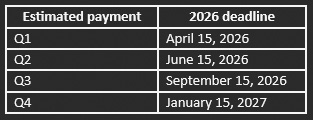
The third-quarter estimated tax payment for 2026 is due September 15, 2026. The September installment is the third required estimated-tax installment of the year. Estimated-tax calculations do not map perfectly to ordinary calendar quarters, especially when the annualized income method is used.
The full 2026 schedule is April 15, June 15, September 15, and January 15, 2027. Notice these are not even three-month blocks the gap between the April and June payments is only two months, which trips people up all year.
September 15 is also the extended filing deadline for calendar-year partnerships and S corporations, so for many business owners, two obligations land on the same day.
Who Needs to Make a Q3 Estimated Tax Payment?
You generally owe estimated tax if you expect to owe $1,000 or more in federal tax for the year after subtracting withholding and refundable credits.
That sweeps in most people whose income is not fully covered by paycheck withholding: the self-employed, business owners taking pass-through income, investors with dividends or capital gains, landlords, and partners or shareholders receiving K-1 income. If you are a high earner using entity and income strategies, estimated payments are almost certainly part of your year.
Even a W-2 employee can owe estimates if a side business, investment income, or a one-time windfall pushes them past what withholding covers.
Not sure whether you are on track this quarter? Ashish walks through a mid-year check-in income, payments, and what to adjust before the deadline in the webinar: How Real Estate Investors Save Big on Taxes with S-Corps, Cost Segregation & Section 179.
Confirm #1: Which Safe Harbor You Are Actually Using
The safe harbor is the rule that protects you from an underpayment penalty regardless of how much you ultimately owe. Meet it, and you are penalty-free even if you write a large check at filing.
You satisfy it by paying, through withholding and timely estimates, the smaller of two amounts: 90% of your current-year tax, or 100% of your prior-year tax. If your prior-year adjusted gross income exceeded $150,000 ($75,000 if married filing separately), that second figure rises to 110% of prior-year tax.
Most people lean on the prior-year number because it is known and fixed, you already filed that return, so there is no guessing. The most common error here is a higher earner using 100% when the rule requires 110%, leaving a gap that quietly accrues interest all year.
Confirm which figure applies to you before you pay. For a broader look at why a solid plan beats guessing, watch Why Your Tax Bill Is Still High (Even With a CPA).
Confirm #2: Whether Your Income Changed Since Spring
This is the confirmation that saves the most money and gets skipped the most.
Your April and June payments were based on what you knew then. If your summer looked different, a stronger quarter, a bonus, a sold property or investment with a capital gain, a new contract, or a slowdown, your Q3 number may need to move up or down.
A large one-time event matters most. Sell an asset in the third quarter and the tax on that gain is generally due with the third-quarter payment, not spread back across the year. If you do not receive income evenly throughout the year, the annualized income installment method may allow required estimated payments to better reflect when the income was actually earned rather than assuming income was earned evenly throughout the year.
Clean, current books make this check fast, the same recordkeeping discipline we cover in our guide to bookkeeping that supports your tax strategy.
Confirm #3: What You Have Already Paid This Year
Before sizing the September payment, add up what has already gone toward 2026: your Q1 and Q2 estimated payments plus any tax withheld from wages, retirement distributions, or other sources.
Withholding gets a helpful quirk, the IRS treats it as paid evenly across the year, no matter when it was actually withheld. That means a bump in year-end withholding can retroactively help cover earlier quarters, a lever estimated payments do not have.
Total what you have paid, compare it to your safe-harbor target, and the September payment is simply the amount that keeps you on pace.
Not sure what your September number should be? Sizing an estimated payment means weighing your safe harbor, your income so far, and what you have already paid, and the penalty for guessing wrong is already running. We can run the numbers with you and map it out in a free consultation before September 15.
Confirm #4: The Penalty Math If You Come Up Short
If a quarterly payment falls short, the underpayment interest starts on that quarter’s due date and runs until the gap is paid, it does not wait until you file.
For the third quarter of 2026, the applicable federal underpayment rate is 7% annually. The estimated-tax underpayment penalty depends on the amount of the shortfall, how long it remained unpaid, and the applicable quarterly underpayment rate. Because it is calculated separately for each quarter, a Q3 shortfall keeps accruing even if you overpay in Q4. You cannot fully undo a missed quarter by catching up later.
The rate resets quarterly, so it can move again on January 1. The practical takeaway: if you are behind, closing the gap sooner always costs less than closing it later.
The surest way to avoid the penalty entirely is to plan ahead of it. Ashish’s Year-End Tax Planning Masterclass: How High Earners Save Six Figures in Taxes Before December shows how getting in front of your number turns each deadline into a non-event.
Confirm #5: Your Payment Method and Do Not Forget State
Small logistics mistakes cause real problems. Confirm the details before you submit.
- Pay through IRS Direct Pay, EFTPS, or with a Form 1040-ES voucher and make sure the payment is applied to the correct tax year and quarter.
- Keep the confirmation number. A payment credited to the wrong year is a headache to unwind.
- Check your state. Most states with an income tax also require quarterly estimates, often due the same day, with their own safe-harbor rules.
Common Mistakes to Avoid
- Paying the same amount as last quarter on autopilot without checking whether your income, gains, or deductions have changed.
- Using the 100% safe harbor when the 110% rule applies based on your prior-year AGI.
- Ignoring a one-time gain, such as a property sale, investment sale, or other windfall that can materially change your Q3 tax projection.
- Assuming a Q4 overpayment will erase a Q3 shortfall. Estimated-tax underpayments are generally evaluated by installment period, so catching up later may not fully eliminate an earlier penalty.
- Forgetting state estimated taxes. State rules can have different thresholds, safe harbors, deadlines, and penalties.
- Applying a payment to the wrong tax year or period. Always confirm the payment is credited correctly and keep your confirmation number.
Want the key dates and checklists in one place? Browse our tax strategy guides and planning checklists built for business owners and investors.
Frequently Asked Questions
When is the Q3 estimated tax payment due for 2026?
September 15, 2026. It is the third of four payments due April 15, June 15, September 15, and January 15, 2027.
How much should my Q3 estimated payment be?
Enough to keep you on pace with your safe harbor, the smaller of 90% of this year’s tax or 100% of last year’s (110% if your prior-year AGI topped $150,000), after crediting what you have already paid and had withheld.
What is the penalty if I underpay?
Underpayment interest, currently 7% for Q3 2026 and compounded daily, accrues on the shortfall from the quarter’s due date. It is calculated separately for each quarter.
Does withholding count toward my estimated taxes?
Yes. Withholding counts toward your safe-harbor target and is treated as paid evenly across the year, even if most of it came late in the year.
I had a big capital gain this summer. Does that change my Q3 payment?
It can. The tax on a third-quarter gain is generally due with the Q3 payment. The annualized income method lets you align payments with when the income was actually earned.
Do I owe state estimated taxes too?
Usually, if your state has an income tax. Most require quarterly estimates with their own due dates and safe-harbor rules, so confirm your state separately.
Final Thought
The Q3 estimated payment is not a copy-and-paste of last quarter. It is a checkpoint.
Confirm your safe harbor, confirm what changed over the summer, confirm what you have already paid, and confirm the logistics, including your state. Five quick checks stand between you and a penalty on income you may not have realized you owed tax on.
Pay as you go, and pay on purpose. That is the whole point of the safe harbor: turn a moving target into a number you control.
Next Steps
- Confirm your safe-harbor target, and whether the 100% or 110% prior-year figure applies to you.
- Review income changes since spring: sales, bonuses, new contracts, or a slowdown.
- Total your Q1 and Q2 payments plus withholding to date.
- Size the September 15 payment to close any gap to your target.
- Confirm the payment applies to the right year and quarter, and keep the confirmation.
- Check whether your state estimate is also due, and pay it.
- When income is lumpy or large one-time gains hit, meet with a proactive CPA. For more free tools and checklists, browse our investor resources.
Stop filing taxes. Start planning them.
At INVESTOR FRIENDLY CPA®, we work with business owners, entrepreneurs, and real estate investors who are serious about building wealth, and keeping it.
TaxMD™ is our proactive tax planning software, built specifically for investors and entrepreneurs like you. It is designed to help you identify what you may be overpaying, capture strategies you could be missing, and put a real tax plan in place year-round, not just in April. Getting started takes about 60 seconds, just answer three quick questions to see where you stand. Try TaxMD™.
In the meantime, schedule a free consultation with INVESTOR FRIENDLY CPA® and let us show you where your biggest opportunities may be hiding.
Because the best time to plan your taxes was yesterday. The second-best time is today.
- The Q3 estimated payment is due September 15, 2026 (a Tuesday).
- The IRS underpayment rate is 7% for Q3 2026, compounding daily on any shortfall from the quarter’s due date, not from filing.
- The safe harbor: pay the smaller of 90% of this year’s tax or 100% of last year’s (110% if your prior-year AGI topped $150,000).
- Each quarter is scored separately. Catching up in Q4 does not erase a Q3 shortfall.
- Confirm what changed since spring, a sale, a bonus, or a strong or weak season can move your number.
- Withholding counts as paid evenly across the year and can help close a gap.



.png)
%20(2).png)
%20(1).png)